Dual-Licensing an Asset Library in 2026: GPLv3, Commercial Waivers, and Zero Runtime DRM
- licensing
- open-source
- business
- developer-tools
- gplv3
- geoicons
When you publish an open-source library, sooner or later you have to decide how it will pay for itself. Asset libraries like icon sets, fonts, and design kits have a harder time than most.
If you release under a permissive license like MIT or Apache 2.0, any company can ship your work inside a paid product and owe you nothing. Meanwhile you answer bug reports on nights and weekends and hope someone clicks the sponsor button.
The usual ways to charge for assets each make the developer experience worse:
- Paywalled tiers. You split the catalog into free and paid sets. A developer installs your library, searches for the country outline they need, finds it locked, and uninstalls.
- Hosted token gateways. You serve icons through an API that checks a token. Now every app depends on your servers, works badly offline, and runs up a cloud bill.
- Monthly subscriptions. You charge every month for static SVG files that never change once they are committed to the repo.
Dual-licensing avoids all three. In this post, we'll walk through how we license GeoIcons, a premium library of geographic map icons, under GPLv3 plus a commercial waiver. You'll see what triggers the copyleft, what the license key does and doesn't do, and the tradeoffs we accepted along the way.
Key takeaways
- The entire catalog ships in one public npm package under GPLv3. There is no free tier and no paid tier of icons.
- If your project is open source under a GPLv3-compatible license, you use GeoIcons for free.
- If you ship closed-source software, you buy a commercial license that waives the copyleft.
- License keys are verified offline. No watermarks, no network checks, and icons always render.
- Dual-licensing only works if you own the copyright to everything you sell, so we don't accept outside code.
One public package, two licenses
Dual-licensing means you release the exact same code under two different licenses and let each user pick the one that fits.
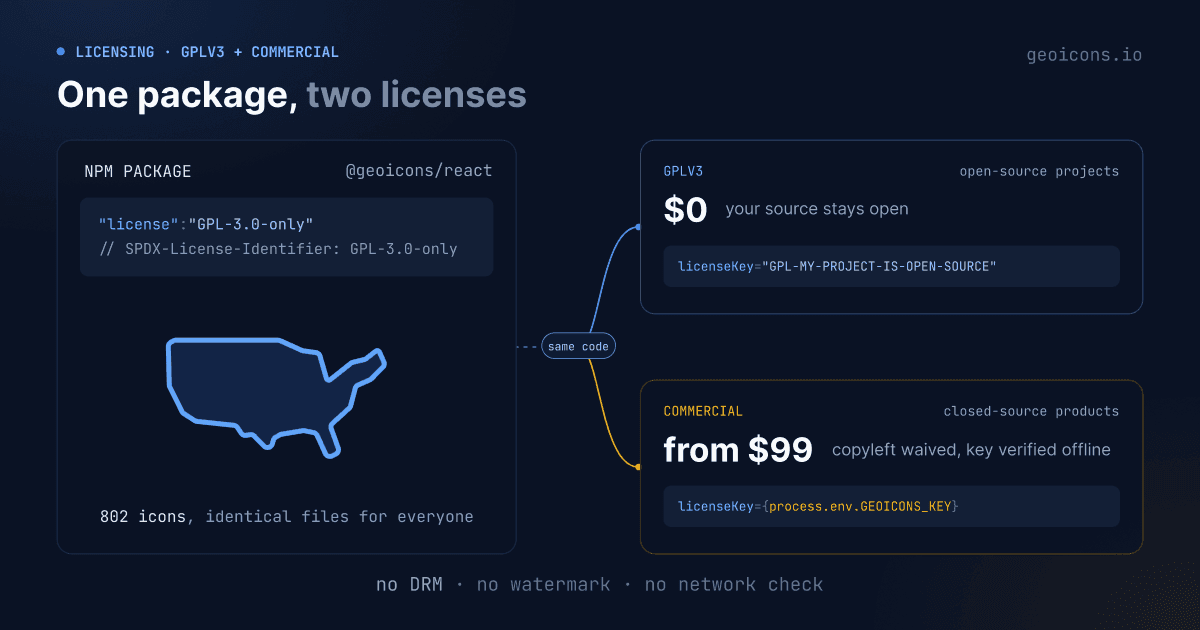
We decided early not to split the package. When you install @geoicons/react, you get all 802 country, area, and subdivision icons. An open-source hobbyist and an enterprise team download the exact same files. As covered in our tree-shaking guide, your bundler keeps only the icons you import, so shipping the full catalog adds nothing to your bundle.
Users differ only in the license they operate under.
Path 1: GPLv3 for open-source projects
If your project is open source, you can use GeoIcons under the GNU General Public License v3 at no cost.
GPLv3 is a copyleft license. It uses copyright law to keep shared code free: you may read, change, and share the code, and anyone who distributes software built on it must pass the same freedoms on. The Free Software Foundation's copyleft guide explains the idea in more detail.
The obligation kicks in when you distribute your software, not when you install a package. GPLv3 calls this "conveying". If you ship an app that contains GeoIcons components to other people, you must offer them your app's source under GPLv3.
That is why we ship compiled framework components (React, Vue, Angular, and vanilla JavaScript) rather than a folder of loose SVG files. The components are code. When your bundler packs them into your app, the Free Software Foundation's position is that the combined app becomes a work covered by the GPL.
If your project is open source, you don't need a license key. Simply pass the GPL declaration string instead, and the console notice goes away:
import { IconProvider } from '@geoicons/react';

export default function Root({ children }: { children: React.ReactNode }) {
  return <IconProvider licenseKey="GPL-MY-PROJECT-IS-OPEN-SOURCE">{children}</IconProvider>;
}
Path 2: A commercial license for closed-source products
Closed-source SaaS products and proprietary apps can't publish their source under GPLv3. If that describes your project, you buy a commercial license. It waives the copyleft and gives your team the explicit right to ship the icons in closed-source software.
Every tier gets the identical, complete icon set. The tier only defines the terms:
| Tier | Covers | One-time | Annual |
|---|---|---|---|
| Hobby | 1 developer, 1 product | $99 | $29/yr |
| Business | Unlimited developers and products | $199 | $59/yr |
| Extended | Unlimited developers, 1 product that redistributes the icons | $399 | $129/yr |
Both options give you the same permanent key, and it never expires. Annual billing costs less upfront and keeps new releases coming. If it lapses, you keep every version you already have. Both include the Figma source file and the raw SVGs.
Extended is for products that hand the icons on to other people: SDKs, website builders, WordPress themes, and HTML templates. Every copy your customers create carries the icons, so this tier is priced above Business. If you only use the icons inside your own app or site, Hobby or Business already covers you.
When does the GPL actually apply?
This is the question we get most often, so here is the short version:
| Your situation | What you need |
|---|---|
| Open-source project under a GPLv3-compatible license | Nothing. Use GPLv3 for free. |
| Public website, web app, or SaaS frontend | Commercial license. Your JavaScript bundle is sent to every visitor's browser, which counts as distributing it. |
| Mobile or desktop app | Commercial license. You distribute the app binary to users. |
| Company with several separate apps or sites | Business license. It covers unlimited products. |
| Template, theme, SDK, or site builder | Extended license. |
This table reflects how we read GPLv3 and our own terms. It is not legal advice. When in doubt, ask your legal team or email us.
A model with a long track record
MySQL has sold a commercial license alongside the GPL since June 2000, and Qt has done the same since Qt 2.2 later that year. Closer to frontend work, Ext JS paired GPLv3 with a commercial license up to version 7.0. FullCalendar Premium offered the same choice until v7, when it replaced GPLv3 with AGPLv3 so that the copyleft also covers your backend. We applied that framework to an SVG icon library.
Why we rejected runtime DRM
Many paid developer tools add technical barriers: watermarks, blurred paths, remote license pings, or export limits. We rejected all of them, for three reasons.
- DRM ruins honest trials. An engineer building a prototype needs clean visuals. A watermark breaks the layout and makes the evaluation pointless.
- DRM causes outages. A network glitch or a crashed license server must never break a customer's site. Icons have to render on every page load.
- DRM doesn't work on open code. Our code is public, so anyone can fork it and delete a check. GPLv3 explicitly lets users modify the code and share their changes (Sections 2 and 5), and it forbids adding further restrictions on top of the license (Section 10). Any lock we added would be legally removable.
What the license key actually does
Commercial buyers receive a license key by email. You pass it once to the license provider for your framework:
import { IconProvider } from '@geoicons/react';

export default function Root({ children }: { children: React.ReactNode }) {
  return <IconProvider licenseKey={process.env.NEXT_PUBLIC_GEOICONS_KEY}>{children}</IconProvider>;
}
The provider checks the key's ES256 signature offline. It makes no network request, so it works in air-gapped builds and never slows down a page. Vue uses the GeoiconsLicense plugin, Angular uses provideGeoiconsLicense(), and vanilla JavaScript uses initGeoiconsLicense(). The commercial license docs cover the React setup, and the Vue, Angular, and vanilla API pages cover the rest.
If there is no valid key and no GPL declaration, the browser console shows a single notice explaining the license. That notice is the only effect. It appears in the browser in every environment, including production, until you add a key or the declaration. It never changes how an icon looks, and icons don't even depend on the provider, so tree-shaking stays intact.
The real enforcement is copyright law. A profitable company won't risk an infringement claim, or a failed due-diligence check during fundraising or an acquisition, to save $99. Their legal teams and dependency scanners flag the GPL long before anything ships, and buying the license is the cheapest way to clear the flag.
Make the license machine-readable
Enterprise compliance runs on automation. Teams run scanners like Snyk, FOSSA, and Mend in their CI pipelines to catch license issues. If a scanner can't read your license, the buying process stalls, so we made the GPL loud and easy to detect:
- Every
package.jsonsets"license": "GPL-3.0-only"using the standard SPDX identifier. - Every generated component file starts with an SPDX header, so the license survives even if someone copies a single file.
- Every package tarball includes the full 674-line GPLv3
LICENSEtext from gnu.org. - Every package also includes
COMMERCIAL-LICENSE.md, so a legal team finds the commercial terms right next to the GPL.
// SPDX-License-Identifier: GPL-3.0-only
// Commercial license available at https://geoicons.io
We chose GPL-3.0-only over GPL-3.0-or-later on purpose. With "or later", Section 14 lets users pick any future GPL version the Free Software Foundation publishes, and your commercial terms would sit next to a license you have never read. "Only" keeps the deal fixed.
When a scanner flags the copyleft, the path to buying has to be fast. We skipped sales calls and calendar invites. A buyer picks a tier on our pricing page, pays through our merchant of record, and receives an invoice and a license key by email right after checkout.
We also skipped user accounts. There are no passwords, magic links, or dashboards. The email is the permanent record of purchase, and if a key gets lost, support re-sends it to the purchase address.
Own every line you sell
You can only sell a commercial waiver for code you own. If someone else wrote part of your library under the GPL, you can't relicense their work to a paying customer.
Projects handle this in one of two ways. Some ask every contributor to sign a contributor license agreement (CLA) that grants relicensing rights. Others don't accept outside code at all.
We picked the second option. Our public repository has pull requests disabled, and the icon components are generated by a build pipeline in a separate private repository. You can still help: open an issue to report a bug or request a missing country or region, and we add it upstream. The tradeoff: we give up drive-by fixes in exchange for a clean, sellable copyright chain.
The commodity risk
Dual-licensing needs an asset set that is hard to replace.
General-purpose icon packs face heavy commodity pressure. If you offer arrows, check marks, and search icons under GPLv3, an engineer will switch to Lucide, Heroicons, or Feather in minutes. A copyleft license pushes users away when a permissive alternative is one tab over.
The model works when your catalog is expensive to rebuild. GeoIcons covers 258 countries and territories, 167 world areas, and 377 state and province outlines. Shapes like these take real care to get right:
Each outline is drawn in Figma, optimized with SVGO, and compiled into React, Vue, Angular, and vanilla components. Before each release, an automated test renders every React component. Rebuilding that set in-house costs a team far more than a license.
We also accept a known downside. Some companies forbid engineers from adding any GPL package, even for a quick prototype. Those teams may never try us. We think clear commercial terms, fast checkout, and good documentation win over the teams that need accurate geography rather than rough stand-ins.
FAQ
- Can I use GeoIcons for free in an open-source project?
- Yes. If your project's own source is released under a GPLv3-compatible license, you can use every GeoIcons package for free under GPLv3. Pass the string GPL-MY-PROJECT-IS-OPEN-SOURCE to the license provider to hide the console notice.
- Do I need a commercial license for a closed-source SaaS app?
- Yes. A web app sends its JavaScript bundle, including the icon components, to every visitor's browser. That is generally treated as conveying under GPLv3, so a closed-source app needs a commercial license to waive the copyleft.
- What counts as one product?
- A product is one application, website, or distributable that ships GeoIcons to end users. Multiple deployments or environments of the same application count as one product. Separate apps, such as a marketing site and a separate SaaS dashboard, are separate products, so a company with several products should choose the Business license.
- Do unlicensed icons show a watermark or stop working?
- No. Icons always render at full quality with no watermark. Without a key or GPL declaration, the browser console shows a single license notice, and nothing else changes. There are no network checks.
- Does a commercial license key expire?
- No. Both one-time and annual purchases give you the same permanent key. Annual billing keeps new releases coming, and if it lapses you keep every version you already have.
- Where can I read the full commercial license agreement?
- The binding terms are published at geoicons.io/commercial-license and included in every npm package as COMMERCIAL-LICENSE.md.
Takeaways for tool creators
Dual-licensing lines up the incentives. Open-source builders get high-quality assets at no cost, and the companies that profit from your work fund its future.
If you build specialized assets or components:
- Pick a copyleft license instead of a permissive default, and pin the version with
-only. - Own every line you sell. Run a CLA or keep contributions to issues.
- Make the license machine-readable with SPDX identifiers, full license text, and headers in every file.
- Publish your prices and let buyers check out without a sales call.
- Skip runtime DRM and respect your users.
To see what this looks like in practice, browse the interactive catalog, compare pricing, or read our launch post.
Sources
- GNU General Public License v3, Sections 2, 5, 10, and 14
- GNU GPL FAQ: statically vs dynamically linked modules
- Free Software Foundation: What is copyleft?
- SPDX License List: GPL-3.0-only
- LWN.net, June 29, 2000: MySQL moves to the GPL
- MySQL commercial licensing for OEMs, ISVs, and VARs
- Qt Wiki: Qt History
- Sencha: GPL licensing FAQ
- FullCalendar: License